
about VAaP
¿Desea ver esta página en español? Seleccione su idioma en la esquina superior derecha.
Quer ver esta página em português? Selecione seu idioma no canto superior direito.
Voulez-vous voir cette page en français ? Choisissez votre langue en haut à droite.
Vle wè paj sa a an kreyòl ayisyen? Chwazi lang ou anlè adwat.
آیا میخواهید این صفحه را به زبان اسپانیایی ببینید؟ زبان خود را در گوشهٔ بالای سمت راست انتخاب کنید.
Jump to:
What is VAAP?
Vermont Asylum Assistance Project (VAAP) is a legal services and technical assistance organization that exists to raise Vermont noncitizens’ awareness of and access to critical immigration legal help and support.
We achieve our mission through statewide direct service delivery, pro bono coordination, peer support, community education, and administrative and legislative advocacy.
Serving as a bridge between service providers and regulators across the state and region, VAAP educates the public on immigration issues and advocates for policies and practices that advance immigrants’ rights.
Our Vermont-based, remote-first staff, service learners, and volunteers represent noncitizens statewide, periodically visiting community-based organizations as well as VAAP’s appointment-only Burlington co-working office, as our dynamic work requires. We are supported by a dynamic board of directors and collaborate closely with legal advocates and lay service providing partners.
What are vaap’s values?
We believe:
Immigration legal status is a means to the ends of noncitizens’ social inclusion, political participation, economic access, and community safety, rather than an end unto itself.
Just results for individuals facing legal harm are possible through authentic, vulnerable, and caring connections, and that the work of making systems more just starts with working on ourselves.
Impacted individuals, families, and communities are experts in their own experiences and needs.
A more equitable, inclusive, and just Vermont is possible for everyone regardless of legal status.
Quality, free legal services are one of many important tools Vermont must make available statewide to help immigrants pursue their individual and collective goals and make the best decisions for their lives.
We act according to our beliefs when we:
Embed legal advocacy within broader movements for equity and belonging, ensuring our services are rooted in a vision of collective liberation, not only legal status attainment.
Foster a culture of self-reflection, emotional integrity, and mutual care within our organization and across our partnerships, recognizing that personal transformation and accountability are essential to systemic change.
Co-create strategies, policies, and programming with community members most impacted by immigration systems, trusting and deferring to their lived expertise.
Center accessibility, equity, and cultural responsiveness in our work, affirming that Vermont’s future must include and uplift all communities, including all immigrant subpopulations statewide.
Expand Vermont’s access to harm-reducing, trauma-informed, and community-connected immigration legal support that respects clients’ agency and strengthens collective resilience.
What Is VAAP’s Vision?
We envision a future Vermont where all residents can access meaningful immigration legal assistance whenever and wherever it is needed, regardless of identity, experience, or status. We advance this mission through the creative, tireless work of a dedicated community of staff, interns, volunteers, directors, supporters, and partners.
Speaking of partnerships, our vision is to change the tide of immigration legal services infrastructure in Vermont for everyone so that all ships rise together. Review our 2025-2028 roadmap for immigration legal services sector development in Vermont.
how can we make vaap’s vision a reality?
Experience from other states shows that a complete, mature immigration legal services sector includes:
Coordinated no-, low-, and full-cost direct services across subfields.
Pro bono support system to mobilize, mentor, and grow attorney volunteers.
Law school clinic pipeline tackling complex cases and projects on referral.
Federal and appellate litigation holding government accountable.
Embedded “crim-imm” advisors within public defense systems.
Statewide civil society coalition uniting immigration providers and allies.
Office of New Americans-equivalent driving public-private coordination (underway with VT 2025 Act 29).
Centralized resource hub (vaapvt.org) modeled on VTLawHelp.org.
Unified intake and referral system with statewide reporting.
who are vaap’s legal service partners?
VT’s immigration and related legal service provider partners, at a glance:
Principles for sustainable, community-rooted growth:
Support, don’t supplant: Build on trusted community infrastructure. For example, VAAP plans to develop and deploy VAAP-supported rural legal support workers who will rotate through community-based organizations (CBOs) on a regular basis to intake and serve clients where they are already at, rather than duplicate CBO infrastructure.
Evidence-based action: Implement data-driven practices and recommendations. For example, VAAP plans to actualize the recommendations from the Vermont Bar Foundation’s 2022-2024 longitudinal immigration legal needs study led by Vermont Poverty Law Fellow Maya Tsukazaki.
Proven models: Adapt successful frameworks from other states. For example, the national Immigrant Justice Corps is partnering with VAAP to pilot rural access to justice measures tin Vermont hat have helped close immigration justice gaps in other states.
Equitable, Vermont-sized solutions: Scale access to match community need, context, and values. For example, VAAP is working with partners statewide to diversify and redistribute immigration legal access more equitably across subpopulations, geographies, language access needs, legal status, and imminence of harm.
Where can vaap & partners grow Together?
Our work plan advances VT’s legal services sector by:
Supporting rather than supplanting existing and community-trusted infastructure, organizations, and institutions.
Implementing recommendations from Maya Tsukazaki’s $250K, Vermont Poverty Law Fellowship 2022-24 legal needs study courtesy of VT Bar Foudation.
Leveraging evidence-based infrastructure from other states proven to maximize social, political, and economic advancement.
Right-sizing immigration legal access infrastructure commensurate with VT values when communties need it most.
Prioritizing equitable, accessible support in every community.
How will VAAP and Partners Get There, together?
In service of our mission and vision, for FY27 we aim to achieve the following goals:
COMING SOON!
We will know we have succeeded in achieving these ends when we:
COMING SOON!
In order to expand and diversify services for objective 1, we will:
COMING SOON!
In order to maintain and strengthen ourselves for objective 2, we will:
COMING SOON!
In order to develop and drive coordination for objective 3, we will:
COMING SOON!
what is the VAAP work plan for fy27?
In our second year of incorporation as a staffed 501(c)(3), VAAP set out to meet a moment of exploding need and sector-wide transformation by expanding the reach, depth, and coordination of immigration legal services across Vermont by (1) broadening and diversifying defensive legal representation in response to evolving needs across case types and counties; (2) strengthening the staff, volunteer, partner, and governance infrastructure necessary to sustain that work; and (3) developing a coordinated intake model so community members know how to seek help and service providers know how to respond effectively.
In practice, we met or exceeded each of our goals and facilitated sector-wide coordination from the courthouse to the state house to the boardroom to make sure changing tides means all boats rise together.
FY26 Impact Infographic forthcoming.
Immigration Legal Services Impact (coming soon!)
People Power Impact (coming soon!)
Policy Change Impact (coming soon!)
Media Momentum Impact (coming soon!)
Education and Outreach Impact (coming soon!)
Revenue and Resilience Impact (coming soon!)
what Was VAAP’s Impact in FY26?
what was vaap’s impact in fy25?
In our first year of incorporation as a staffed 501(c)(3), despite systemic and existential threats, VAAP set out to establish a strong foundation from which to increase immigration legal access in Vermont through long overdue capacity building, volunteer mobilization, and resource generation. In practice, we made tremendous impact on immigration legal access in Vermont and established ourselves as an organization that is here to stay.
Click here to review our FY25 Impact infographic.
1. Immigration Legal Services Impact
50 full-scope cases opened, many protecting entire family units.
300+ asylum seekers served through clinics and walk-in events.
5 detained Vermonters returned home, and many more were screened or advised.
13 proceedings terminated and 35 immigrant juvenile cases opened.
Hundreds of applications filed, with dozens of work permits and benefits successfully issued.
2. People Power Impact
30+ volunteer attorneys contributed 3,000+ hours, supporting over 65 families.
VAAP grew from a solo Executive Director to 4 lawyers with support staff, with 2 more joining in late 2025.
40+ service learners contributed over 5,000 hours of support.
4 volunteer attorneys embedded, providing 3,000+ hours of direct representation to 30+ clients.
Dozens of volunteer interpreters helped save $20K+ in language access costs.
3. Policy Change Impact
5 pro-immigrant bills passed in Vermont (Acts 28, 29, 31, 66, and 69).
VAAP staff testified at 10+ hearings and presented on 3 panels in the State House.
Appointments to key committees, including the Federal Transition Task Force, VT Legal Hub Advisory Board, and the VT Judiciary’s Access to Justice Coalition.
Contributed to right-sizing state infrastructure, easing burdens on legal staff.
4. Media Momentum Impact
Created 2 podcasts and multiple KYR (Know Your Rights) videos in English, Spanish, French, and Creole.
Published 4 op-eds, appeared on 2 local TV shows, and achieved 30+ earned media hits from outlets including VTDigger, VT Public, NBC Boston, and the Washington Post.
Reached 62K site views and 25K unique visitors; materials were available in five languages.
Sent 25K newsletters with a 54% open rate (up 35%).
Engaged thousands at the grassroots level.
5. Education and Outreach Impact
Hosted a 400+ attendee Symposium focused on supporting pro se applicants.
Led dozens of KYR trainings across 13 of 14 VT counties.
Presented 12+ CLEs and panels, encouraging volunteerism in VT, NY, MA, and Quebec.
Weekly coordination with 10+ partners and extensive in-person and online training.
6. Revenue and Resilience Impact
Achieved $500K+ revenue growth, doubling FY25 income despite the loss of over $300K in federal funding.
Supported by 11 board members working across 3 committees.
Continued to serve as Vermont’s first host site for Immigrant Justice Corps (IJC) law fellows — 2 fellows hosted last year, 2 more in FY26.
Appointments to national and regional legal committees, enhancing VAAP’s visibility and technical leadership.
WHO are VAAP’s clients?
VAAP serves noncitizens in Vermont. For people seeking family- and employment-based pathways, we can share information and recommend trusted private practice attorneys. For humanitarian status seekers, like asylum seekers, we can screen for relief and hopefully offer direct immigration application assistance. Most people seeking help from VAAP are asylum seekers who have experienced forced migration, circumstances that pushed them away from their homelands and pulled them to Vermont as a place of refuge. While we might think about migrants collectively as “refugees,” the reality is that relatively few noncitizens arrive with “refugee” legal status. Instead, most immigrants are under- or undocumented and must submit applications to regularize immigration status and meet immediate and long-term goals.
What are VAAP clients’ goals?
Most immediately, VAAP clients’ most immediate goals are avoiding death, bodily harm, confinement in detention, and banishment through deportation. Once immediately safe, clients’ material goals include accessing a safe place to sleep, food and medicine for themselves and their families, and the opportunity to earn income to make the first two sustainable. Long term, most VAAP clients hope to live safely with their families free from the threat of deportation from the U.S. and free from the threat of harms faced in their countries of origin, let alone free to participate safely and equitably in public and political life.
What legal options further VAAP clients’ goals?
Quoting attorney Sarah Morando Lakhani, U.S. law offers three main pathways to regularized immigration status: family-based (based on “blood” relationships), employment-based (based on “sweat” relationships), and humanitarian-based (based on “tears” relationships).
Programs like VAAP focus on humanitarian pathways and removal defense, which are typically too time-intensive, politicized, and unstable for private bar coverage. Unfortunately, humanitarian pathways require applicants to excavate and display the depths of their worst experiences here or abroad without the outcome of justice being served. “Justice” isn’t an option for most but—depending on the bad things that have happened to them here or abroad—the law might offer tools to help clients meet at least some extraordinarily valid goals like immediate safety and meeting material needs.
When can VAAP clients become authorized to work?
Obtaining work authorization is usually VAAP clients’ most urgent goal. In the U.S., a work authorized social security number is the necessary precursor to working safely, opening a bank account, traveling safely between states, securing financing, and accessing public services and financial aid. Importantly, work authorization is not an independent immigration benefit for which one can apply.
Work authorization is only available incident to some other pending or approved pathway, whether through “blood,” “sweat,” or “tears.” Rules and processing times vary by pathways. Asylum seekers can apply for work authorization 180 days (or six months) after filing for asylum, and rules are always changing.
All eligible individuals can apply for work authorization by submitting proof of eligibility and a current USCIS Form I-765.
What is asylum?
Since the mid-20th century, international and federal law have mandated that the U.S. must "withhold" removal of people who fear harm for things about themselves they cannot change or shouldn’t have to change (“protected grounds”) from which their government can’t or won’t protect them. In 1980, the Refugee Act added the option of discretionary asylum as an added benefit to withholding, offering more permanent status, family reunification, and potential U.S. citizenship. Asylum and withholding are just two of many “tears” based humanitarian immigration pathways and people are not limited to pursuing one at a time. Success depends not only on finding affordable counsel, which isn’t provided, but also on proving the “right” kind of harm to the “right” part of their marginalized identity at the “right” time and place. Even imminent death upon deportation is often insufficient.
Who is an asylum seeker?
When crossing international borders, forced migration is strictly regulated by law.
When crossing inward across U.S. borders, forced migration is often wrongly labeled “illegal.”
Federal law requires only that a person be present and afraid to invoke their right to a fair hearing on eligibility for asylum or withholding.
There is no “wrong” way to seek asylum. Anyone present and afraid with an unexhausted claim is, by law, an asylum seeker.
People cannot be “illegal” and the “a- - - -” word is harmful, even when being read out loud directly from the U.S. Code
What does asylum seeking look like in Vermont?
In Vermont, the number of asylum seekers has risen sharply in recent years, but the state’s capacity for legal and advocacy support has not kept up. With one of the lowest attorney-to-population ratios in the country, Vermont struggles to provide asylum seekers with the legal representation they need, whether paid or pro bono. Without legal counsel, asylum seekers face enormous challenges in obtaining work authorization and meeting basic needs. They are also three to five times more likely to be denied asylum and deported, often to life-threatening situations.
In response, community-based organizations have stepped up to fill the gap. One example is the Community Asylum Seekers Project, which became VAAP’s first fiscal sponsor in 2016. VAAP builds on our partners’ on-the-ground expertise by combining it with strong legal connections. Together, we create a statewide resource center to train, mentor, and support attorneys and advocates while connecting them with asylum seekers who need help. Vermont is now home to a growing number of people seeking safety from countries like Haiti, the Northern Triangle, the African continent, and Afghanistan.
As an independent 501(c)(3), VAAP aims to expand this network of legal support. By leveraging our partners’ resources and expertise, we can provide hundreds more people with fair access to the legal system, the regulated economy, safe social inclusion, and the chance to live with dignity.
What are the risks & Benefits of seeking asylum?
Applying for asylum protects a person from deportation from the moment the application is received by the government through to when a decision on that application becomes final, which can take years or even decades. Soon after applying, the asylum-seeker becomes eligible for work authorization which they can maintain so long as their application remains pending. If approved, an asylee can apply for public assistance, can sponsor their spouses or children to join them in the U.S. with asylee status, can apply for a travel document with which to travel safely outside and inside the U.S., and can apply for adjustment of status to lawful permanent residence (a “green card”) after one year.
For most VAAP clients, preparing and filing asylum applications is materially emergent, but must be handled with caution and care. The sworn testimony those applications contain will follow an asylum-seeker throughout their immigration journey, lasting many years and possibly decades. Under the REAL ID Act, any inconsistent statements anywhere in the record of proceedings, however immaterial to the heart of the legal claim, can be used to find the asylum seeker “not credible” and deny their application. Denied applicants have limited appeal rights and, once exhausted, the government orders them “removed” and likely physically deports them. If the law prevents the government from granting someone asylum as a matter of discretion, the person may still be able to have their removal “withheld” but without the added benefits of permanent status, family reunification, or the ability to travel internationally.
How does An asylum seeker start their case?
If immigration officers detain a noncitizen within 100 miles of a U.S. international border, which includes most of VT, they can apply for asylum by stating (and repeating) that they are afraid of returning to their country of origin, want to be screened for asylum, and want to speak to an attorney.
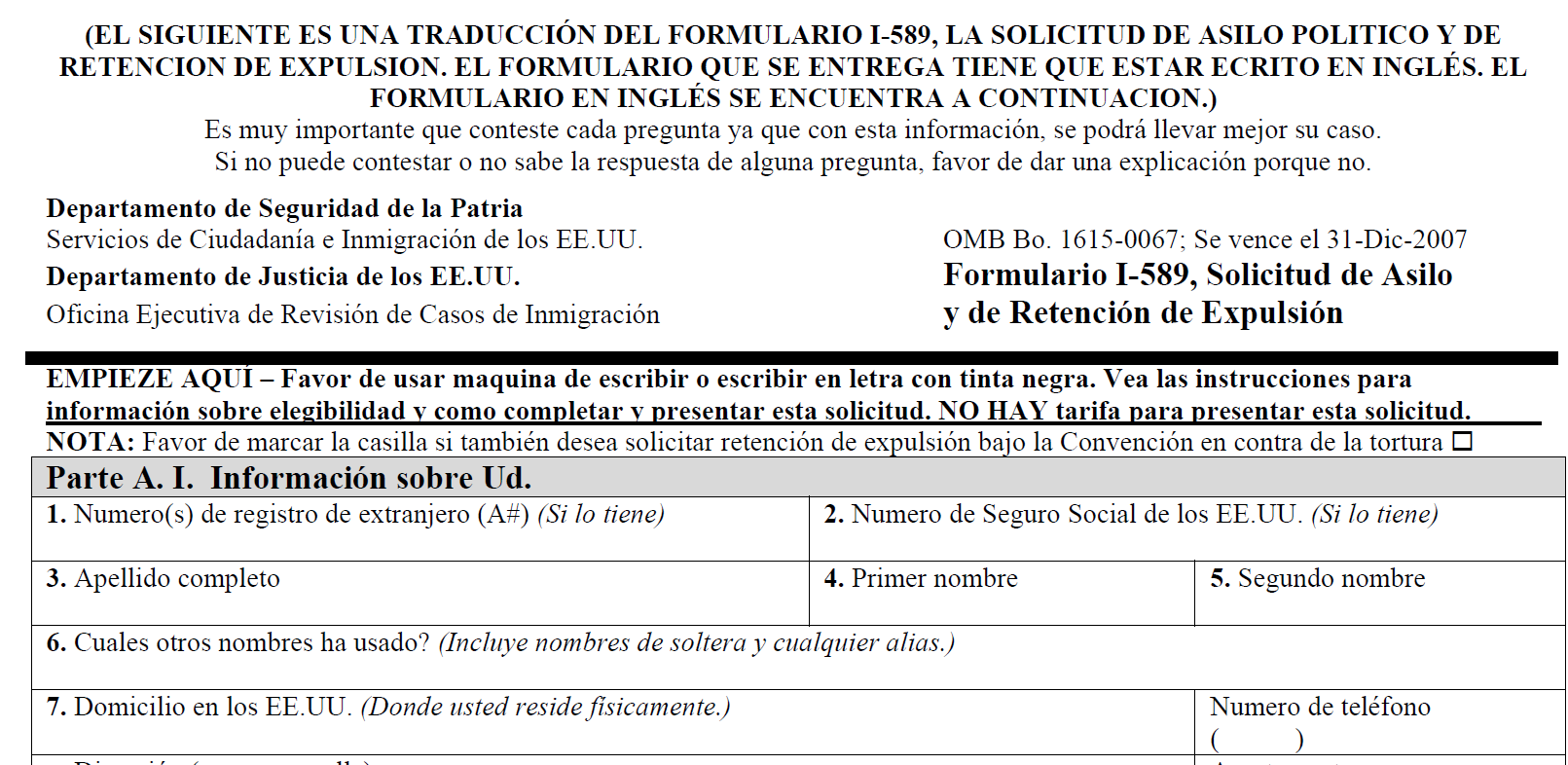
If a noncitizen is in the U.S. and not in removal proceedings before the Immigration Court, they can apply for asylum by filing a current USCIS Form I-589 with U.S. Citizenship and Immigration Services.
If a noncitizen is in the U.S. and in Immigration Court removal proceedings, they can apply for asylum by filing a current USCIS Form I-589 with the Immigration Court.
what makes a winning claim for asylum?
Without access to legal counsel, an asylum seeker is exponentially less likely to be granted asylum and instead be deported, often into life-threatening situations.
Even with representation, the Executive Office for Immigration Review reported an asylum grant rate of only 41% in 2024.
Under these unfavorable circumstances, VAAP aims to give Vermont noncitizens more just and open access to the U.S. immigration legal system so they can exercise as much voice and choice as possible in our community and live a life of dignity—or at least meet their immediate safety and material needs along the way.
We achieve this by providing direct immigration legal representation, by mobilizing private practice attorneys to volunteer their services, by building community capacity to navigate the system by themselves, and by advocating and coordinating at systems levels to generate more resources and make sure existing resources are being used to the fullest.
Does VAAP work on cases not involving asylum claims?
Asylum is central to VAAP’s founding and present work, but it is only one part of what we do. VAAP also helps Vermont immigrants identify and pursue a broader range of legal options, including:
Humanitarian protections for survivors of crime, trafficking, gender-based violence, and other serious harm.
Special Immigrant Juvenile Status for immigrant youth who have been abused, abandoned, or neglected.
Family-based immigration options for mixed-status families and loved ones seeking stability.
Employment-based pathways, including emerging opportunities for Vermont employers to sponsor workers for long-term status.
Removal defense and cancellation of removal for longtime community members facing deportation.
Federal court and constitutional litigation, in partnership with pro bono litigators, when immigration agencies violate due process, civil rights, or basic fairness.
VAAP’s strength is holistic issue-spotting and client-centered litigation strategy: we do not look at a person’s case through only one lens. Through our staff, volunteers, partners, and leadership in the Vermont Bar Association Immigration Section, we break down silos between humanitarian, family, and employment pathways; transactional and litigation interventions; removal or “defensive” versus non-removal or “affirmative” procedures; and administrative versus federal proceedings. We do this so all of Vermont’s immigrant communities can access every available legal pathway to safety, stability, and justice.
what options do Migrant workers and other longtime residents have?
More than people think. Even if someone has lived or worked in Vermont without immigration status, a careful legal screening may uncover pathways to protection, work authorization, or permanent residency. Common options we screen for include:
Humanitarian protections for survivors of crime, trafficking, family violence, or other serious harm.
Asylum-related protection for people who fear persecution or torture if returned to their home country.
Special Immigrant Juvenile Status for young people who have been abused, abandoned, or neglected.
Temporary Protected Status or parole for people from countries with qualifying crisis conditions.
Family-based petitions through U.S. citizen or permanent resident relatives.
Employment-based sponsorship, including opportunities for Vermont employers to sponsor indispensable workers for long-term status.
Removal defense strategies, including cancellation of removal and other protections for people facing deportation.
The most important first step is comprehensive legal screening. Many workers assume they have “no options” because they are undocumented or came for economic reasons, but economic survival and legal protection are not mutually exclusive. VAAP helps workers and families identify every possible pathway before they are pressured into giving up their rights or leaving the country without counsel.
With Ice Detaining More and More people, how many detained immigrants have viable asylum claims?
More than ICE wants people to believe. Many people detained by ICE are bona fide asylum seekers with real, legally recognizable fears of return. Detention does not erase the right to seek protection and be protected under U.S. law:
People have the right to be heard. Anyone in the U.S. who fears return to their home country can ask for protection, including asylum, withholding of removal, or protection under the Convention Against Torture.
Irregular entry does not bar asylum. Many asylum seekers enter without inspection because poverty, race, language, passport access, and visa barriers leave no safe or lawful way to reach protection.
Most detention is not about public safety. Many detained immigrants have no criminal record and are held for civil immigration violations like presence without status or entry without inspection.
Criminal charges do not always end protection claims. Even when a conviction limits asylum eligibility, people may still qualify for withholding of removal or other protection from deportation to danger.
Asylum is not the only pathway. Detained people may also qualify for family petitions, Special Immigrant Juvenile Status, U or T visas, VAWA, TPS, parole, or employer-based options.
Interim protection matters. Even when a person does not ultimately win asylum, stopping deportation can create the time needed to pursue other lawful pathways and protect family unity.
The urgent problem is access. ICE and CBP increasingly use detention, pressure, misinformation, and isolation to push people to give up their rights before they can speak with counsel.
VAAP’s role is to make sure detained people are screened before they are forced out of the process. The problem is not that people lack claims. The problem is that the system is making it harder for them to assert the rights Congress already guaranteed.
How many detained asylum seekers have access to legal counsel?
Far too few, and it changes everything. Detained immigrants are dramatically more likely to pursue and win protection when they have lawyers, but most people in detention face the system alone:
Only 14% of detained immigrants had legal counsel in the American Immigration Council’s major national study of immigration court cases, compared with about two-thirds of people who were not detained.
Lawyers change outcomes. Detained people with counsel were nearly 11x more likely to seek relief and about twice as likely to win relief if they applied.
At the credible fear screening stage, counsel is almost nonexistent. Human Rights First reported that 99% of asylum seekers were unrepresented during completed credible fear proceedings, and over 90% were unrepresented in asylum merits interviews.
Detention makes access nearly impossible. People are isolated from family, phones, documents, interpreters, and community support — exactly when they most need legal help.
Long delays pressure people to give up. Immigration courts now face a backlog measured in the millions, with asylum seekers often waiting years or decades for resolution.
Waivers of asylum-seeking rights are often coerced. Many detained people sign deportation orders or give up hearing rights before they understand their options or speak with counsel.
Legal screenings are urgent. Many detained people have viable claims, but no meaningful way to identify or assert them without help.
VAAP’s detention work is about making the right to counsel real. When we enter facilities, we are often the first to explain what rights exist, screen for protection, reconnect people with family and evidence, and intervene before someone is deported without a fair hearing.
How does detention impact Asylum success?
Detention dramatically lowers an asylum seeker’s likelihood of success, not because claims lack merit, but because detention blocks access to the process. People in ICE custody face isolation, coercion, lack of counsel, limited evidence access, and rushed fear screenings controlled by enforcement agencies:
Without counsel, success rates are extremely low. The Congressional Research Service reported that only 19% of unrepresented asylum seekers achieved relief, compared with 47% of represented asylum seekers (CRS, 2024).
Detained people are much less likely to have lawyers. A major American Immigration Council study found that only 14% of detained immigrants had counsel, compared with 66% of non-detained immigrants (American Immigration Council, 2016).
Lawyers also help people get out of detention. Detained immigrants with counsel were four times more likely to win release on bond, which gives them a better chance to gather evidence, support their families, and prepare their cases (American Immigration Council, 2016).
Detention suppresses outcomes from the start. Credible fear and reasonable fear screenings are often controlled by enforcement agencies like ICE and CBP, not neutral adjudicators.
Coercion distorts the record. Detainees may be pressured to waive claims, sign deportation papers, or proceed without interpretation, counsel, medication, food, or meaningful explanation of their rights.
The officer’s version often becomes the official record. When detained people cannot document objections or get legal help quickly, violations disappear from the file.
The result is artificially low success. A detained asylum seeker’s odds often reflect detention conditions, geography, counsel access, and coercion — not the actual strength of their fear-based claim.
The bottom line: detention turns asylum seeking from a legal process into an endurance test. VAAP’s role is to intervene early, preserve rights, connect people to counsel, and make sure strong claims are not lost simply because someone was jailed before they had a fair chance to be heard.
How many in Vermont have had temporary protection revoked and now risk detention?
Nationally, well over 1.5 million people have been put at risk of losing temporary legal protection. That includes more than 1 million TPS holders and roughly 500,000+ people with humanitarian parole, including CHNV parolees from Cuba, Haiti, Nicaragua, and Venezuela. (WLRN / States Newsroom; DHS CHNV notice):
The biggest parole loss is CHNV. DHS terminated the Cuba, Haiti, Nicaragua, and Venezuela parole program, affecting about 532,000 people who had entered through a lawful humanitarian process. (AP; Federal Register)
TPS losses are also massive. Reporting and policy analysis estimate that the administration has moved to terminate TPS protections for more than 1 million people, with hundreds of thousands losing work authorization and protection from deportation. (WLRN / States Newsroom; Penn Wharton Budget Model)
We do not have a precise Vermont number. TPS and parole data are administered federally and are not reliably reported at the state level, so Vermont-specific estimates remain incomplete.
VAAP estimates that Vermont has a couple hundred residents with temporary protections, including TPS, humanitarian parole, and CHNV parole.
Many people who lost temporary protection may still have options. That can include asylum, family-based petitions, employment sponsorship, U or T visas, VAWA, Special Immigrant Juvenile Status, withholding of removal, or other humanitarian protections.
The biggest barrier is counsel. Many people with strong claims have not applied for asylum or other relief because Vermont does not have enough immigration attorneys, and people know how much harder it is to win without representation.
VAAP is building the missing data infrastructure. Through coordinated statewide intake and support for Vermont’s Office of New Americans study committee under Act 29, we are working to identify TPS holders, parolees, and others losing temporary protection — and connect them to screening before ICE pressure turns a temporary status loss into deportation.
The bottom line: the national numbers are enormous, but Vermont’s numbers are still too invisible. VAAP’s work is to make sure people who lose TPS or parole are not treated as out of options before anyone has actually screened them.
How can I work with VAAP?
Contact VAAP:
Request Legal Assistance
📧 info@vaapvt.org
📱 +1 802-999-5654
🔗 Follow: @VTAsylum
📖 Learn: www.vaapvt.org